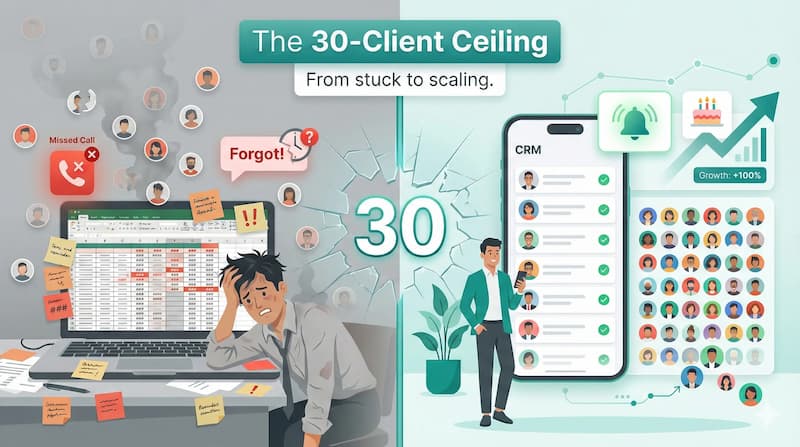
An insurance agent in Kuala Lumpur has 35 clients. She knows each one personally. She remembers birthdays, family details, policy preferences. Her renewal rate is 95%. Clients love her.
Then she hits 50 clients. The birthday wishes arrive late. A motor renewal slips past. She calls Ahmad to discuss his medical card and accidentally references details from a conversation she had with a different Ahmad.
At 80 clients, she's drowning. Not because she's bad at her job, but because her brain physically cannot hold 80 sets of relationships in active memory.
She's hit the 30-client ceiling. And most professionals never break through it.
Why 30? The Biology of Forgetting
This isn't about discipline or intelligence. It's neuroscience.
Dunbar's Number, a concept from evolutionary psychology, suggests humans can maintain roughly 150 meaningful social connections. But that includes family, friends, old classmates, neighbours. Your professional contacts share that 150-slot brain with everyone else in your life.
For client relationships that require active context (what they bought, when to follow up, what they mentioned last time), most professionals max out at 20-30 people without a system.
Beyond that, you start:
- Confusing one client's details with another's
- Forgetting follow-up dates you told yourself you'd remember
- Missing renewals because you didn't check your calendar that day
- Feeling overwhelmed instead of in control
This isn't a character flaw. It's a storage limit. And you can either fight your biology (and lose) or extend your memory with a system (and win).
The Real Cost of the Ceiling
"Forgetting" sounds minor until you calculate what it costs.
The Forgotten Follow-Up Tax
Forget to follow up with 1 lead per week. Assume only 25% of those would have converted.
- 52 missed follow-ups/year x 25% conversion = 13 lost deals
- At RM 1,000 average commission = RM 13,000/year gone
That's one forgotten follow-up per week. Most professionals above 30 clients miss more than that.
The Renewal Leak
Without a system, insurance agents typically miss 5-10% of renewals. At 50 policies with RM 500 average renewal commission:
- 5% missed = 2-3 missed renewals = RM 1,000-1,500/year
- 10% missed = 5 missed renewals = RM 2,500/year
These aren't dramatic losses. They're slow, invisible bleeds that compound year over year. You don't notice the clients who quietly leave. You only notice when your income plateaus and you can't figure out why.
The Growth Cap
This is the biggest cost, and it's invisible.
Professional A (no system):
- Acquires 15 new clients/year
- Loses 10 clients/year (30% churn from neglect)
- Net growth: 5 clients/year
- Year 5: 55 clients, earning RM 110,000/year
Professional B (with a CRM):
- Acquires 15 new clients/year (same acquisition effort)
- Loses 3 clients/year (10% churn)
- Net growth: 12 clients/year
- Year 5: 90 clients, earning RM 180,000/year
The 5-year difference: RM 70,000 in cumulative lost income. Not because Professional A worked less hard. Because they hit the ceiling and couldn't grow past it.
Over 10 years? The gap becomes RM 200,000+. Same person, same skills, same market. Different system.
What Happens Above 30 Clients
If 30 is the ceiling, what does life look like above it?
30-50 Clients: The Danger Zone
You know you're forgetting things, but you're not sure what. You compensate by working harder: staying up late reviewing your spreadsheet, scribbling notes after meetings, setting 15 different phone alarms.
This is the stage where most professionals either:
- Burn out trying to muscle through with memory alone
- Plateau and accept 30-50 clients as "enough"
- Get a system and break through
50-100 Clients: System-Dependent
At this level, memory is completely insufficient. Every professional managing 50+ clients uses some kind of system, whether it's a CRM, a detailed spreadsheet ritual, or a notebook method.
The question isn't whether you need a system. It's whether your system scales.
Spreadsheets break down here because they don't remind you. They store information, but they don't surface it. You have to remember to check the spreadsheet, remember which tab, remember what column. That's using memory to manage your memory tool, defeating the purpose.
100-300 Clients: Professional Scale
The top earners operate at this level. They're not working 3x harder than the person with 30 clients. They have 3x the system.
At this level, a CRM is non-negotiable. Every morning shows exactly who needs attention. Every client interaction is logged. Renewals, birthdays, and follow-ups surface automatically.
It compounds from there:
- Happy clients renew → stable recurring revenue
- Happy clients refer → free client acquisition
- More clients → more referrals → exponential growth
The professional with 200 well-managed clients earns more per hour than the one with 50 poorly-managed clients. Because their system does the remembering while they do the relationship-building.
Breaking Through: What Actually Works
Step 1: Accept the biology
You are not going to remember everything. Stop trying. The most successful professionals aren't the ones with the best memory. They're the ones who stopped relying on memory earliest.
Step 2: Choose a system that reminds you
The critical feature isn't "storing contacts." Your phone already does that.
The critical feature is automated reminders. A system that tells you every morning: here are the 5 people who need your attention today. Here's why. Here's the context from your last conversation.
That's the difference between a database and a system. Your follow-up strategy is only as good as the system supporting it.
Step 3: Build the 5-minute daily habit
Every morning, open your CRM. Check today's reminders. Act on them. Log the interactions.
This takes 5 minutes. It replaces 30+ minutes of "let me think about who I should call today" and "wait, when was I supposed to follow up with Ah Seng?"
Step 4: Trust the system, not your brain
The hardest part isn't setting up a CRM. It's trusting it. For the first week, you'll still try to remember everything. You'll double-check the CRM against your mental list.
After two weeks, you'll notice something: the CRM caught things you forgot. A birthday you would have missed. A follow-up you would have skipped. That's when trust clicks in. And that's when you start scaling past 30.
The Test: Where Are You Right Now?
Answer honestly:
- Do you know every client's next follow-up date? (If no, you're already missing things)
- Can you name every client whose birthday is this month? (If no, you're missing connection opportunities)
- Could you tell me what you discussed with any given client last time you spoke? (If no, your interactions lack continuity)
- Do you feel in control of your client relationships? (If no, you've hit the ceiling)
If you answered "no" to any of these, you're leaving money on the table. Not because you're bad at your job, but because you're human. And humans forget.
So What Now
Your brain has a limit. Your business shouldn't.
The professionals earning RM 10,000+ per month aren't smarter. They aren't working longer hours. They have a system that does the remembering so they can do the relationship-building.
The cost of not having that system isn't just missed follow-ups. It's a permanent cap on your growth. It's the difference between managing 30 clients forever and scaling to 200+.
The ceiling is real. But it's not a wall. It's a choice.
Ready to Break Through?
Try JomClient free. No credit card required.
- Unlimited contacts on the free plan
- Automated reminders that surface who needs attention today
- Full client timeline so you never forget what you discussed
- Built for teams and professionals who want to grow past 30 clients
Your memory has limits. Your system shouldn't.